
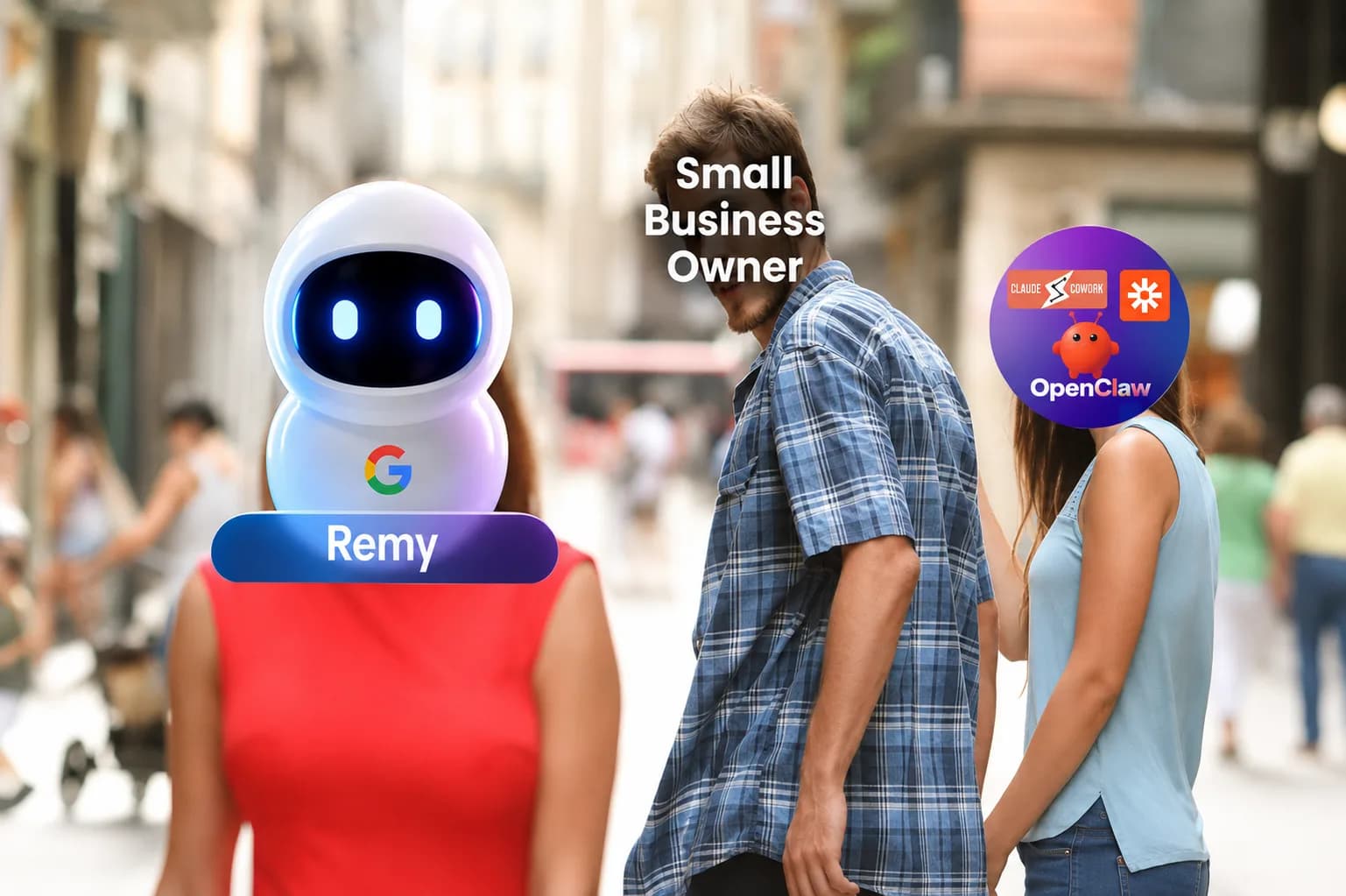
Picture Emma. Monday morning, 8:47am.
Her inbox has 73 unread messages. Three meetings need rescheduling because a client moved a workshop. A supplier has been waiting four days for an answer she keeps meaning to write. The MD wants a project status update by lunchtime. The new starter cannot get into the shared drive.
Emma is the operations manager at a 12-person consultancy. She is also the person who answers when the printer stops working, the one who set up everyone's two-factor authentication last year, and the closest thing the business has to an IT department. Her actual job, the one on her contract, is something else entirely.
This morning, she opens Gemini and asks it to help her draft a polite chase email to the supplier. Six months from now, she will not need to ask. She will tell it the goal, and it will handle the chase, the rescheduling, the project update, and the new starter's access request. It will report back when it is done.
That shift has a name. It is called agentic AI. And Google is about to put it inside the Workspace subscription that Emma's business already pays for.
From answering to doing
Most people now have a rough idea what tools like ChatGPT and Gemini do. You ask a question, you get an answer. You ask for a draft, you get a draft. Useful, but the work of doing something with that draft still falls back to you.
An agent is different.
An agent takes a goal and works out the steps. It opens the right tools, does the right things in them, and reports back. The shift from "answer my question" to "complete this task for me" is the entire story.
Today's Gemini will write you a draft chase email if you ask for one. Tomorrow's Remy will read your inbox, find the supplier conversation, write the chase, send it, mark the thread for follow-up in three days, and tell you it has done so.
That is not a bigger answer machine. It is a different category of tool.
- Today's chatbots answer; agents act, completing multi-step work and reporting back when done
- The same goal moves from "draft an email I can send" to "handle this conversation and tell me when it is closed"
- Treat agentic AI as a new category of tool, not a faster version of the one you already use
What Remy actually is
Remy is the codename for an agent Google is currently building. It is being tested internally by Google staff inside their own version of the Gemini app, and the details we have come from internal documents reported by Business Insider in early May.
Google describes Remy as a 24/7 personal agent that can take actions on your behalf, monitor things that matter to you, handle complex tasks proactively, and learn your preferences over time. It is designed to be deeply integrated across Google's products.
Public availability is not yet confirmed. Google's annual I/O developer conference runs on 19 and 20 May, which is the most likely moment for an early preview. Whether and when Remy lands inside Google Workspace specifically is not yet announced, but Google's pattern over the last two years suggests Workspace is where it ends up.
For Emma's business, that timing matters. It means agentic AI is not a future technology to think about in 2028. It is a 2026 question.
- Remy is a Google internal codename for a personal agent designed to act, monitor and learn preferences over time
- Public availability is not confirmed, Google I/O on 19 and 20 May is the most likely first preview window
- Workspace is the most plausible landing pad based on Google's product pattern over the last two years
What it actually looks like in practice
None of these are speculative. They are the kind of work that an agent in the Remy mould is built to do.
Inbox triage. Emma opens Gmail to 73 unread emails. Remy has already read them, sorted them by priority, drafted replies to the four that need replies, flagged the two that need her decision, and archived the marketing noise. Her inbox is now a short queue of four drafts to approve and two questions to answer. The morning starts at 9am instead of 10:15.
Calendar reshuffling. A client cancels a Wednesday workshop at short notice. Emma tells Remy to handle it. Remy moves the three internal meetings that were blocked off for prep, finds the next slot that works for everyone, sends the updated invites, and emails the client a polite suggestion of three alternative dates from the team's actual availability. Time taken: about 90 seconds.
Project status updates. Every Friday, Emma builds a one-page update for the MD by trawling Drive, the shared inbox, and the calendar. Remy can read across all three, pull the relevant updates, draft the page in the format she normally uses, and have it ready before she sits down with her coffee.
Watching for things that matter. Emma asks Remy to flag any email that mentions the new compliance project, any calendar invite from the regulator, and any document edit by the external auditor. She does not need to check. Remy will tell her.
These are not enterprise-grade automations that take a consultant six weeks to build. These are tasks an agent can pick up the day it lands in your Workspace. This is the territory where AI workflow automation stops being a slide in a vendor deck and starts being something a 12-person business can actually run.
- Inbox triage, calendar reshuffles, weekly status drafts and quiet monitoring are all in scope from day one
- None of these need a six-week consulting engagement to set up, that is the genuinely new thing
- Identify three repeating tasks where someone in your business loses an hour a day, and start there
Why this matters more for small businesses
Large businesses have had this kind of automation for years. They have automation teams, integration platforms, and the budget to pay people whose entire job is connecting the dots between systems.
Small businesses have not had any of that. They have had Emma.
Remy, and the agents that will follow it, change that calculation. For the first time, the same class of automation that a 5,000-person enterprise has been buying for half a million pounds a year arrives inside a tool a 12-person business already pays for as part of its monthly Workspace subscription.
That is the genuinely new thing. Not the technology itself, but its presence inside the subscription you already pay for.
It also means the businesses that benefit most are the ones least equipped to think about it. Enterprises have governance teams, security architects, and procurement processes that will pause and ask the right questions before letting an agent act on the company's behalf. Emma does not have any of those. She has her job, and the printer.
- For the first time, enterprise-grade automation arrives inside the Workspace bill a small business already pays
- The businesses with the most to gain are the ones with the least governance to think it through safely
- That gap is where a sensible IT partner earns their keep, not by selling the agent, but by framing how it is allowed to operate
Questions every owner should be able to answer
Before any agent, Remy or otherwise, is allowed to act on behalf of your business, the owner should be able to answer four questions.
What is the agent allowed to do, and what is it not allowed to do? Drafting a reply for approval is one thing. Sending an email to a client without a human reading it first is another.
Whose account is it acting as? An agent does not have its own identity. It borrows yours. If Emma's agent acts on her account, every action it takes looks, to the rest of the world, exactly like Emma did it.
What happens when it gets something wrong, and how would you know? Agents fail occasionally. The question is whether you find out the same day or the same quarter.
Who is responsible for the outcome? If the agent sends the wrong file to the wrong client, that is not the agent's mistake. It is the business's mistake.
These are not IT questions. They are owner questions. The right IT consulting partner can help you implement the answers. They cannot decide them for you.
- Decide what the agent may do and where a human must approve before it acts
- Remember the agent is borrowing a real person's identity, every action looks like that person took it
- Plan how you would notice a mistake, not just hope you do not make any
- Keep accountability with the business, the agent is a tool, not a defendant
What to do now
You do not need a strategy yet. You need a few small, specific steps.
Get your Google Workspace foundations in order. Make sure two-factor authentication is on for everyone, admin access is held by named individuals only, and Drive sharing is not set to "anyone with the link" by default. An agent built on top of a tidy Workspace is a useful tool. An agent built on top of a messy one is a faster way to make existing problems worse. If you would value an outside view of the basics first, that is the kind of work that sits naturally inside managed IT services.
Decide, as a leadership team, what you would want an agent to be allowed to do. Write it on a single side of A4. You will not get it perfect. You will get it started.
Talk to your IT partner about how you would test an agent safely when it arrives. The right partner will already be thinking about this. Letting software act on behalf of your business is, at its heart, an AI security question dressed up as a productivity one, and it overlaps directly with your wider cybersecurity position.
Plan for the licence cost. If Remy launches as expected, getting the most out of it in a business setting will likely mean a mid-to-high Workspace tier, roughly £14 to £22 per user per month at the base, with potentially more for full agent access. Expect it to feel like an evolution of the Gemini features already inside Workspace rather than an entirely separate product. For the latest, check workspace.google.com or the official Google announcements.
Watch Google I/O on 19 and 20 May. If Remy is previewed there, you will know what is coming and roughly when.
- Tighten Workspace basics first, an agent on top of a messy tenant is a faster way to make problems bigger
- Write a one-page position on what an agent may and may not do before any vendor demo arrives
- Treat agent rollout as a security and governance decision, not a productivity buy
- Budget for a tier upgrade and watch I/O on 19 and 20 May for the first proper preview
The agent is coming
Six months from now, Emma's Monday morning will look different. The 73 emails will already be triaged. The supplier chase will have gone out on Friday. The project update will be drafted. She will spend the morning making decisions, not pushing pixels around an inbox.
That is the promise. It is real, it is close, and for the first time it is affordable for businesses the size of yours.
Whether your business is one of the ones that benefits, or one of the ones that gets caught out, will not come down to the technology. It will come down to whether the leadership team decided in advance what they wanted from it.
The agent is coming. The question is what you will let it do.
At Blue Icon IT, we help London businesses adopt tools like Gemini, and the agents that will follow it, without losing control of their data, their identities or their compliance position. If you would value a calm conversation about what to do before Remy lands, get in touch.