
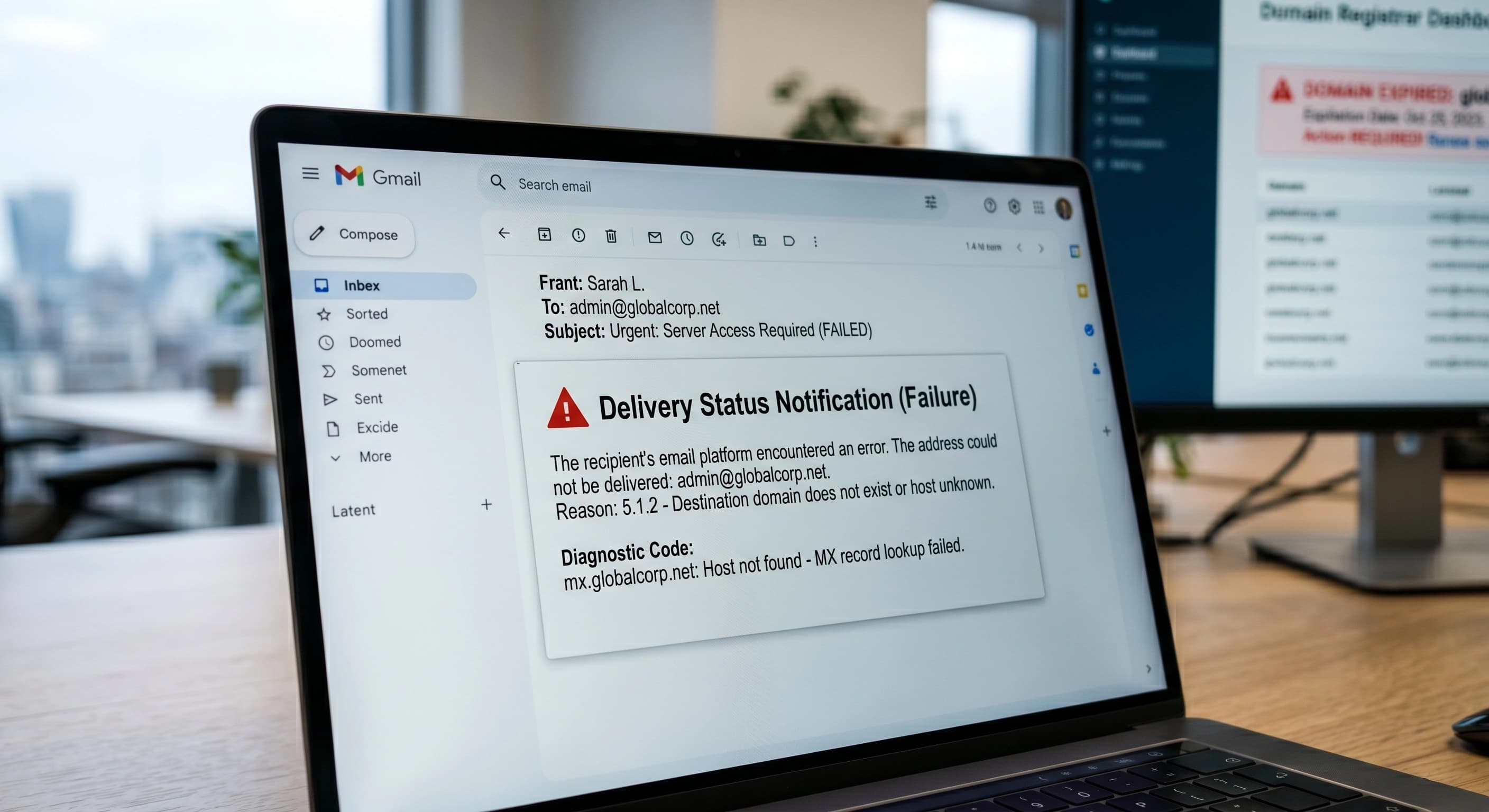
A business we know forgot to renew their domain name. That is it. That is the whole story. A renewal that should have been automatic was not set up properly, and nobody was watching.
The minute the domain expired, every single email sent to the company started bouncing back. Client emails. Proposal responses. Contract approvals. All of them returned to sender with an error message. Every file sharing link the company had ever sent out stopped working. Documents that clients and partners relied on suddenly led nowhere.
The only communication channel still functioning was Slack. But externally, to the clients and contacts who mattered most, the business had effectively vanished.
By the time someone worked out what had happened, the damage was not technical. It was reputational. Clients had received bounce-back errors with their name on them. Partners had clicked on dead links. The impression was not "they had an IT hiccup." The impression was "this company cannot manage its own infrastructure."
A domain renewal costs about £10 a year. The reputational cost of that oversight is still being paid off.
This is what happens when nobody is watching. And it is far more common than most business owners realise.
What Is Break-Fix IT Support?
Break-fix IT support is exactly what it sounds like. Something breaks, you call someone, they come and fix it, and they send you a bill.
There is no ongoing contract. No monitoring. No one watching your systems to catch problems early. You only interact with your IT support when something has already gone wrong.
It is the oldest model in the industry, and for decades it was the only option most small businesses had. You kept an IT person's number in a drawer and hoped you did not need to use it too often.
In simple terms, break-fix IT support is a pay-as-you-go model where you only call for help after something has already gone wrong.
For very small businesses with minimal technology needs, it can make sense. But for any business that depends on its technology to operate, and in 2026 that is virtually every business, this model carries costs that are not obvious until they hit.
- Break-fix is reactive by design, you pay per incident with no ongoing relationship
- It worked when technology was peripheral to the business, not when it is the business
- The headline "pay only when you need us" hides several costs that never show up on an invoice
What Is Managed IT Support?
Managed IT support works on an entirely different principle. Instead of waiting for things to fail, a managed service provider monitors your systems continuously, maintains them proactively, and works with you on a strategic level to plan your technology roadmap.
You pay a fixed monthly fee. That fee covers monitoring, maintenance, helpdesk support, security oversight, and regular strategic reviews. The provider's incentive is to keep everything running smoothly, because problems that escalate cost them time and resources too.
Managed IT support is a fixed-fee model where a provider proactively monitors and maintains your systems to prevent problems before they happen.
Think of it as the difference between only seeing a doctor when you end up in A&E versus having regular check-ups, screening, and a GP who knows your medical history. Both involve medical professionals. Only one is designed to keep you healthy.
- Fixed monthly fee in exchange for proactive monitoring, maintenance and strategic input
- Incentives align with yours, the provider loses money when your systems fail
- A team supports you, not a single person whose phone you hope rings on the right day
The Hidden Costs of Break-Fix IT That Nobody Talks About
The appeal of break-fix is obvious. You only pay when something goes wrong. On paper, that looks cheaper than a monthly retainer you pay regardless of whether anything happens.
But that calculation only works if you ignore everything the invoice does not show you.
The Hourly Rate Is Not the Real Price
Most break-fix IT engineers in London charge somewhere between £75 and £150 per hour, with emergency or out-of-hours rates often significantly higher. That sounds manageable until you look at what a typical incident actually involves.
The initial call-out is just the start. There is diagnostic time while the engineer works out what went wrong. There are parts or software licences that get added to the bill. There are follow-up visits when the first fix does not hold because nobody investigated the root cause.
And because break-fix engineers have no ongoing visibility into your environment, every visit starts from scratch. They do not know your setup. They do not know your history. They are solving the same puzzle every time, and you are paying for every minute of that learning curve.
The hourly rate is the price on the sticker. The total cost of ownership is something else entirely.
The Cost of Downtime You Cannot Invoice For
The domain name story is one example. But let us look at an even more common scenario and do the maths.
A 30-person professional services firm in London. The server goes down on a Thursday afternoon. The IT guy is on another job. He can be there in two hours. Maybe three. For the next four hours, the team sits idle.
Average billable rate across the team: £150 per hour. Not every member of staff bills directly to clients, so let us be conservative and say 20 of the 30 are fee earners.
20 fee earners × £150 per hour × 4 hours of downtime = £12,000 in lost billable time.
That is just the direct revenue loss. It does not include:
The cost of missed deadlines and the client relationships damaged by them. The reputational impact when your firm cannot respond to urgent client requests for an entire afternoon. The overtime or weekend work your team puts in to catch up, and the morale cost that comes with it. The knock-on effect on projects that were already running tight on schedule.
A reasonable estimate for the total business impact of a four-hour outage for a firm of this size is somewhere between £15,000 and £25,000. The break-fix repair bill might be £300.
The repair is not the expensive part. The disruption is.
The Cost of the Work That Does Not Get Done
There is another cost that almost never appears in any calculation, because it is invisible until you go looking for it.
In most businesses with 10 to 50 employees, there is someone who has quietly absorbed responsibility for IT without ever being hired for it. The office manager who resets passwords. The operations director who troubleshoots the printer. The HR lead who onboards new starters onto systems they barely understand themselves.
These are the people I call the accidental IT managers. They were hired for one job and ended up doing two.
Every hour that person spends wrestling with a technology problem is an hour they are not doing the work you actually hired them for. Their real job, the one that drives your business forward, gets pushed to the margins. And because the IT work is urgent and their actual work is merely important, the urgent wins every time.
The cost is not what you pay the accidental IT manager to deal with technology. The cost is what they would have delivered if they had been left to do their actual job.
The Cost of No Strategy
Break-fix IT is purely reactive. Nobody is asking whether your infrastructure can handle the growth you are planning. Nobody is reviewing whether your backup strategy will actually work when you need it. Nobody is assessing whether the way your team uses technology is creating security vulnerabilities.
There is no technology roadmap. There is no planning. There is no one in your corner thinking about where your business needs to be in 12 months and whether your IT can get you there.
This cost does not show up on a balance sheet. It shows up when you try to take on a major new client and your systems cannot cope. It shows up when you try to enable remote working and discover your infrastructure was never designed for it. It shows up when a cyber incident happens and you realise nobody was watching the door.
The absence of strategy is free right up until the moment it becomes the most expensive thing in your business.
- Hourly rates hide diagnostic time, parts, repeat visits and the cost of an engineer who starts every visit from cold
- A four-hour outage for a 30-person London firm can cost £15,000 to £25,000 in total business impact, dwarfing the repair bill
- "Accidental IT managers" drain the business twice, once in lost productivity, once in the real work that never happens
- The absence of strategy is free, until it is the most expensive thing in the business
Break-Fix vs Managed IT: A Direct Cost Comparison
When businesses compare break-fix and managed IT, they almost always start with the monthly number. Break-fix has no monthly cost. Managed IT does. On that basis alone, break-fix looks cheaper.
But monthly cost is the wrong metric. Total cost of ownership across a year is what matters.
Here is how the two models compare for a typical 30-person London business:
Cost predictability. Break-fix costs are completely unpredictable. You might spend nothing one month and thousands the next. Managed IT gives you a fixed monthly fee you can budget for with confidence.
Response times. Break-fix response depends on your engineer's availability. If they are busy, you wait. Managed IT providers operate with defined service level agreements and typically have teams available, not just one person.
Downtime frequency. Break-fix does nothing to prevent outages. Managed IT actively monitors for warning signs and resolves potential issues before they escalate.
Security posture. Break-fix provides no ongoing security oversight. Managed IT includes continuous monitoring, patch management, and regular security reviews as part of a broader cybersecurity posture.
Strategic planning. Break-fix offers none. Managed IT includes regular technology reviews and roadmap planning aligned with your business goals.
Total annual cost. A managed IT contract for a 30-person business in London typically ranges from £3,000 to £6,000 per month depending on complexity. That is £36,000 to £72,000 per year. A single significant outage under the break-fix model can cost £15,000 to £25,000 in total business impact. Two or three of those in a year, combined with ongoing ad-hoc support costs, and break-fix is not the cheaper option anymore. It just felt like it was.
The bottom line: managed IT costs more per month, but break-fix costs more per year when you account for downtime, lost productivity, and the absence of strategic planning.
- Monthly cost is the wrong metric, total cost of ownership across a year tells the real story
- Managed IT wins on predictability, response times, security posture and strategic planning
- Two or three serious outages a year close the gap completely, and often flip it the other way
How to Know If You Have Outgrown Break-Fix
Not every business needs managed IT. If you have five employees, minimal technology, and your work does not depend on systems being available every hour of the day, break-fix might be perfectly adequate.
But most businesses reach a tipping point, and many have already passed it without realising. Here are the signals:
You have more than 15 employees. At this size, the complexity of your technology environment starts to exceed what an ad-hoc approach can reliably manage.
You have had more than two unplanned outages in the past twelve months. If your systems are failing regularly, the absence of proactive monitoring is already costing you.
Someone on your team spends significant time on IT who was not hired for it. If your office manager or operations lead has become your de facto IT department, you are paying twice for them and getting half the value from either role.
You handle sensitive client data. Professional services, legal, financial, and healthcare firms have regulatory obligations around data protection. Break-fix provides no framework for meeting your compliance obligations.
Your IT person has no backup. If your IT guy goes on holiday, gets ill, or simply does not answer the phone, you have no fallback. A managed provider has a team.
You are planning to grow. Growth puts strain on infrastructure. If nobody is planning your technology roadmap, growth will expose every weakness in your setup at the worst possible moment.
If three or more of these apply to your business, you have almost certainly outgrown break-fix.
- More than 15 employees, regular outages, or an "accidental IT manager" on the team are all clear signals
- Handling sensitive client data raises the floor, break-fix gives you no framework for compliance
- Growth plans expose every weakness in an unmanaged setup, usually at the worst possible moment
What Managed IT Services Should Actually Include
If you decide to explore managed IT, it helps to know what a proper agreement looks like. Not every provider offers the same thing, and some managed contracts are little more than break-fix with a monthly direct debit.
A genuine managed IT service should include:
Proactive monitoring and alerting. Your systems should be watched around the clock, with alerts triggered before small issues become big ones.
Patch management and updates. Software updates and security patches should be applied systematically, not left until someone remembers.
Helpdesk support. Your team should have a clear, reliable way to get help with day-to-day IT issues without relying on one person's availability.
Cyber security oversight. This means more than antivirus software. It means ongoing monitoring, threat assessment, and a security posture that evolves as threats do.
Regular strategic reviews. A good managed IT provider sits down with you periodically to review your technology, align it with your business plans, and identify risks or opportunities.
Backup and disaster recovery planning. Not just having backups, but having tested, documented recovery plans that your provider has verified actually work.
Vendor management. Dealing with your internet provider, your phone system supplier, your software vendors. An outsourced IT partner should handle these relationships so you do not have to.
If a provider cannot clearly articulate what their monthly fee includes, or if their offering is vague on proactive monitoring and strategic planning, keep looking.
- Proactive monitoring, patch management, helpdesk and security oversight are the non-negotiables
- Regular strategic reviews and tested disaster recovery separate a real managed service from break-fix with a direct debit
- If a provider cannot clearly articulate what is included, that is the answer
The Real Question
A domain renewal costs about £10 a year. A managed IT provider would have caught it months before it expired. Instead, a business lost client trust, professional credibility, and weeks of relationship repair because nobody was watching a date on a calendar.
That is not a technology failure. It is a leadership failure. And the question is not whether managed IT costs more per month than break-fix.
The question is whether your business can afford what break-fix costs you when it matters most.
If you want to understand what a managed IT setup would look like for your business, and what it would actually cost compared to what you are spending now, book a free strategy call with us. No obligation. No sales pitch. Just an honest conversation about whether your current approach is serving you or silently holding you back.
Book Your Free IT Strategy Call
Related reading: The complete guide to managed IT services, The true cost of IT downtime for professional services, and How to choose the right MSP in London.