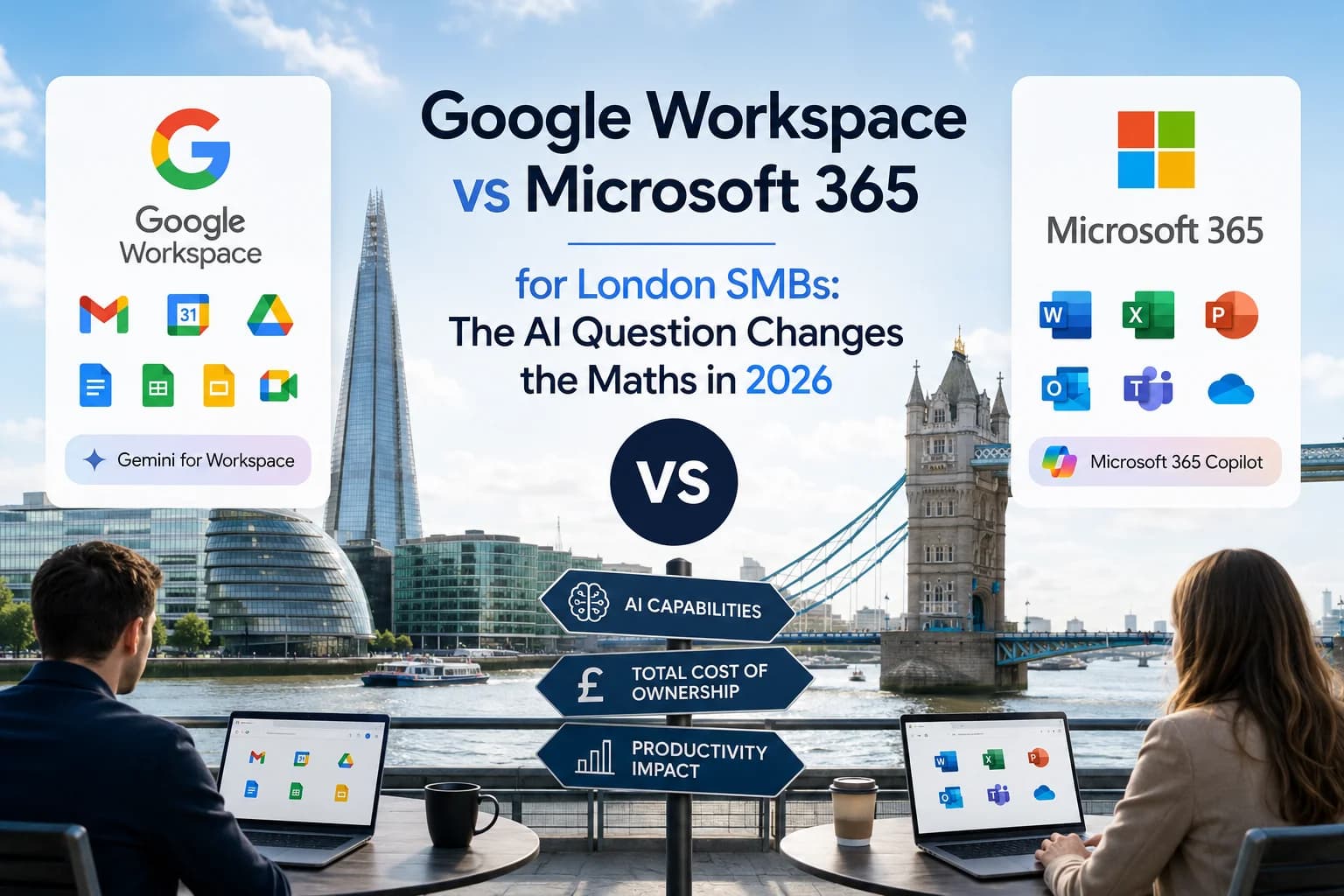
On 1 July 2026, Microsoft is raising prices on most Microsoft 365 plans by up to 33 percent. On 15 April, the free Copilot features inside Word, Excel and PowerPoint disappear for anyone without a paid Copilot licence. Two events, six weeks apart, that should be making every London SMB recalculate its productivity stack. Almost none of them are.
The Workspace versus Microsoft 365 question has been settled for so long that most operations managers have stopped asking it. The platform was chosen on day one by a founder who liked Outlook or who had used Gmail at their last job. Everyone learned to live with whichever side that decision landed on. Twelve months on, with both Google and Microsoft now charging for AI in fundamentally different ways, the maths underneath that old decision has quietly become the most expensive variable on the IT budget.
This piece is about what changed, what it costs, and what an honest answer looks like for a London SMB renewing in 2026.
A settled question that just unsettled itself
For a decade, the Google Workspace versus Microsoft 365 choice was boring. Pick a side, accept the trade-offs, get on with running the business. Microsoft was stronger on documents and spreadsheets. Google was stronger on real-time collaboration and Gmail. The licence price difference was small enough to be a rounding error against staff cost, and any feature gap could be papered over with a third-party tool.
That balance held because the underlying product was mature on both sides. Neither vendor was changing what their suite actually did. They were polishing it.
In 2025 that ended. Both Google and Microsoft decided that generative AI was no longer optional, and both chose to put it inside their core productivity suite. The decisions they made about how to charge for it are the reason this comparison is worth writing in 2026. The unit economics now diverge in ways the old comparison never had to deal with.
- The Workspace vs Microsoft 365 decision has been treated as settled for a decade in most London SMBs
- Both vendors have changed how they charge for productivity software in the last twelve months
- The licence comparison that used to be a rounding error now sits at the top of the IT budget
What actually changed in 2025: Gemini bundled, Copilot unbundled
Google moved first. In January 2025, Gemini was bundled into Workspace Business Standard, Business Plus and Enterprise plans. The standalone Gemini add-on, which had been selling separately for around twenty dollars per user per month, was retired. Prices on the bundled plans rose between 17 and 22 percent to absorb the cost. The decision was not optional. There is no way to subscribe to Workspace Business Standard in 2026 without paying for Gemini, whether your team uses it or not.
Microsoft took the opposite route. Copilot remained a paid add-on, sitting on top of the existing Microsoft 365 licence. The promotional rate runs at £13.80 per user per month until 30 June 2026, after which the list price returns to £16.10. From 15 April 2026, the lightweight Copilot Chat that has been embedded inside Word, Excel and PowerPoint for any subscriber will be pulled out. After that date, AI inside the core Office apps is only available on seats with a paid Copilot licence attached. Microsoft is also raising base Microsoft 365 prices on 1 July 2026, with most Business and Enterprise plans going up by between 8 and 33 percent.
Two vendors. Two opposite strategies. Google decided AI was a feature. Microsoft decided AI was a separate product. The buyer pays for both decisions in different ways.
- Google: Gemini bundled into Workspace Business Standard and above, base plan prices up 17 to 22 percent
- Microsoft: Copilot stays as a paid add-on, free in-app Copilot features removed from 15 April 2026
- Microsoft 365 base prices rise on 1 July 2026 by between 8 and 33 percent depending on plan
The new maths in pounds: a 25-person London SMB worked example
A worked example makes the gap visible. Take a 25-person London consultancy renewing in summer 2026, comparing three honest options at current UK list prices, excluding VAT.
Google Workspace Business Standard, with Gemini bundled into every seat, costs £11.80 per user per month. For 25 users that is £3,540 per year. AI included for everyone, no separate licence to manage.
Microsoft 365 Business Standard sits at £9.40 per user per month, cheaper on the base licence. Add Copilot at the current promotional rate of £13.80 per user per month and the total jumps to £23.20 per seat. For 25 users that is £6,960 per year, almost double the Google figure.
Run the same Microsoft scenario at the list prices that apply once the promotional period ends on 30 June 2026 and the gap widens further. The base licence rises to roughly £10.50 per user per month, Copilot returns to £16.10, and the combined seat cost lands at £26.60. For 25 users, £7,980 per year. Add VAT and the same firm is spending nearly £9,600 to put AI inside the Office apps for everyone.
The Microsoft 365 Business Premium tier holds steady at £17.60 per user per month and brings a stronger security stack with it. Adding Copilot at list price brings the seat to £33.70 per user per month. For 25 users, £10,110 per year before VAT.
Three configurations. One platform. Roughly two to three times the cost of the Google alternative for the same headline outcome, which is AI sitting inside the productivity apps the team uses every day.
| Configuration (25 users) | Per user / month | Annual cost (ex VAT) | Multiple vs Workspace |
|---|---|---|---|
| Google Workspace Business Standard (Gemini included) | £11.80 | £3,540 | 1.0x |
| Microsoft 365 Business Standard + Copilot (promo rate) | £23.20 | £6,960 | 2.0x |
| Microsoft 365 Business Standard + Copilot (list, post 1 July 2026) | £26.60 | £7,980 | 2.3x |
| Microsoft 365 Business Premium + Copilot (list) | £33.70 | £10,110 | 2.9x |
- The base licence is cheaper on Microsoft 365, the total cost with AI is roughly double or more
- The Microsoft 365 price increase on 1 July 2026 widens the gap by another £1,000 a year for a 25-person team
- Business Premium is the only Microsoft tier where the security stack arguably justifies the premium on its own merits
The maths is worse than it looks: Microsoft 365 Copilot adoption is failing
The comparison above assumes Copilot for every user, which is how most procurement spreadsheets land in the renewal conversation. The reality is harder for Microsoft.
According to Recon Analytics, surveying more than 150,000 respondents in early 2026, only 35.8 percent of employees with a paid Microsoft 365 Copilot licence actively use it. ChatGPT's equivalent conversion rate is 83 percent. Microsoft's own quarterly disclosures show roughly 15 million paid Copilot seats globally, which is only 3.3 percent of the total Microsoft 365 user base. Multiply the two figures together and the genuinely active Microsoft 365 Copilot user base lands at around 1.2 percent of all Microsoft 365 seats.
The trend is also moving the wrong way for Microsoft. Among paid AI subscribers tracked by Recon Analytics, Copilot's share fell from 18.8 percent in July 2025 to 11.5 percent in January 2026, a 39 percent contraction in six months. Gemini overtook Copilot in paid subscriber share in November 2025.
What that means for the 25-person London firm is straightforward. Pay £4,830 a year for Copilot at list price across the team and, on the industry conversion average, eight or nine people will actually use it. The other sixteen will close the Copilot side panel within a week and never reopen it. The cost per active user is therefore not £16.10 per month. It is closer to £45.
| Metric | Microsoft 365 Copilot | Google Workspace Gemini |
|---|---|---|
| Available to | Paid Copilot seats only | 100 percent of Business Standard and above |
| Share of suite users with the AI | ~3.3 percent of M365 users pay for it | ~100 percent of qualifying Workspace users |
| Active usage among licensed users | 35.8 percent | Not directly comparable, no separate paywall |
| Net actively-using share of total suite base | ~1.2 percent | Significantly higher by default |
| Paid subscriber share trend (Jul 2025 to Jan 2026) | 18.8 percent to 11.5 percent (down 39 percent) | Overtook Copilot in November 2025 |
This is the editorial point Microsoft does not want made in print. Copilot is not failing in the lab. It is failing on the desks of the people paying for it. The product is technically capable. The adoption gap is real.
For balance, Copilot can work. Accenture rolled it out to 743,000 employees and reports an 89 percent active usage rate. That outcome cost Accenture a tailored change management programme, one-to-one leadership training, dedicated internal communications and a sustained executive push. The 25-person London consultancy does not have those resources. The Accenture exception proves the SMB rule. AI inside an enterprise suite produces value when the foundations are there. Without them, it produces invoices.
- Only 35.8 percent of paid Microsoft 365 Copilot licences are actively used, against 83 percent for ChatGPT
- The genuinely active Copilot user base is around 1.2 percent of all Microsoft 365 seats globally
- Roll out at list price to a 25-person firm and the effective cost per active user is closer to £45 per month than £16
- Where Copilot works in the wild, it works because of expensive change management, not the product itself
Copilot vs Gemini: a short capability comparison
None of this means the platforms are interchangeable. The AI features each vendor sells do different things in different ways.
Gemini works well inside Gmail for drafting and summarising. It is strong in Sheets for formula and data work, capable at long-document analysis thanks to its larger context window, and helpful in Meet for live transcripts and summaries. It is weaker where Google's own apps are weaker, which is mainly heavy document editing in Docs.
Copilot is strongest inside Excel for analysis and chart generation, inside PowerPoint for first-draft slides from a Word brief, and inside Teams for meeting recap and action tracking. It is weaker when the data it needs is not already inside Microsoft 365.
The point that matters: the vendor's AI only sees the vendor's data. If your business runs on Google Drive, Gemini wins by default. If your business runs on SharePoint and Teams, Copilot wins by default. Switching platforms for the AI alone is almost never the right call once migration cost is in scope. The choice you actually have is whether AI is on at all, not which vendor's AI to switch to.
- Gemini is strongest in Gmail, Sheets and Meet, weakest in Docs against a heavy document workflow
- Copilot is strongest in Excel, PowerPoint and Teams, weakest when relevant data lives outside Microsoft 365
- The AI only sees its own vendor's data, so the platform you already run on usually decides for you
- Switching platforms for the AI alone is almost never the right call once cloud migration cost is in scope
The London SMB context: who picks Workspace vs Microsoft 365
Most London SMBs do not have a free choice between Workspace and Microsoft 365. They have a constrained one.
Professional services firms, the bulk of the London SMB economy, skew heavily Microsoft. Legal, accountancy, finance, property, recruitment and consultancy work all run on Outlook, Excel and SharePoint. The clients these firms sell into have Microsoft-shaped security questionnaires and SSO requirements. A small London firm pitching for enterprise work spends less time defending Workspace than it would saving on licence cost.
Creative, marketing and agency firms skew Google, along with most tech-adjacent startups. Faster-moving teams, more browser-based work, less reliance on the deep Office app stack. Document collaboration in Docs is genuinely easier than the SharePoint equivalent.
The platform decision is rarely made on a balanced scorecard. It is made by who your clients are, what your team learned on, and what your finance system already integrates with. The AI question piles on top of an existing decision more often than it forces a new one.
- Professional services firms in London almost always run on Microsoft 365 because their clients do
- Agencies, creative studios and startups skew Google Workspace for collaboration speed
- The AI debate rarely overturns a platform decision once switching costs are in the model
The leadership reframe: AI is only as good as your data foundations
The headline question on every IT renewal in 2026 looks like Workspace versus Microsoft 365 with AI in the middle. The honest version of that question is different.
The honest version is whether the business is running enough of an IT operation to make any AI add-on worth paying for. Both Gemini and Copilot are grounded in your own data. They work by reading your files, your emails, your shared drives and your meeting recordings, and producing useful output on top of what they find. The quality of the output depends entirely on the quality of what they find.
If your file structure is chaotic, your permissions are broken, sensitive documents sit in personal Dropboxes, and half the team still emails attachments instead of sharing links, no AI in 2026 will rescue that. The AI will look in the wrong places, retrieve out-of-date information, and produce confident summaries of incorrect facts. This is exactly the territory where a proper managed IT services engagement earns its keep, by getting the foundations honest enough that AI can actually do its job.
This is why AI is quietly failing inside SMBs. The technology is not weak. The foundations are not there. The vendor sells a productivity revolution. The buyer gets an expensive summarise button, and then blames the AI rather than asking whether anyone ever fixed the file structure it has to read from.
- Gemini and Copilot are only as accurate as the data they are pointed at
- Chaotic file structures and broken permissions produce confident but wrong AI answers
- Fixing the foundations is cheaper, more useful and more durable than rolling AI out across the team
A renewal decision framework for the accidental IT person
Three honest questions to take into the renewal conversation, in order.
1. Where does your data actually live today, and is it tidy enough for AI to be useful? If the answer involves three different shared drives, two ex-employees still having access, and a folder structure that nobody has rationalised in four years, AI is not your next problem. Data hygiene is. Fix the foundations before you pay extra for AI to read them. A short IT consulting engagement against your current tenant will tell you exactly where you stand.
2. Who on your team will use AI weekly, and what for? A small group of power users, usually three to five people in a 25-person firm, will get genuine value out of either Gemini or Copilot. Most of the rest will not. Naming those people in advance, and planning training for them specifically, is worth more than a blanket licence rollout. If AI workflow automation is going to land, it will land here first.
3. What is your renewal timing? The Microsoft price increase on 1 July 2026 is real money on the table. If your renewal falls after that date, a conversation about locking in current pricing before 30 June is worth having now. If your renewal falls before, you have a year of breathing room to do the other two questions properly.
For most 10 to 50 person London SMBs, the answer that survives all three questions is: stay on your current platform, do not roll AI out to everyone, run a small pilot with the people who will use it. That is also the answer that protects your cybersecurity position, because every Copilot or Gemini seat is also a seat with broad read access to your business data.
- Audit your data hygiene before paying for AI, the AI will only be as useful as the files it reads
- Identify the three to five power users who will genuinely use AI weekly, licence them, skip everyone else
- If your renewal falls after 1 July 2026, lock in current Microsoft pricing before the increase
- Default answer for most London SMBs: stay put, pilot AI narrowly, fix the foundations in parallel
Closing
The AI question changes the maths but it does not change the fundamentals. Productivity gains do not come from a tick-box on a renewal form. They come from people who know what to ask, working from data that is structured enough to be asked about.
Both Google and Microsoft will keep pushing both platforms toward "AI included." The advisory question is the same as it has always been. What does your business actually do? What does your team actually use? And what would it look like to spend the money on the foundations instead?
At Blue Icon IT, we help London SMBs make honest decisions about Google Workspace, Microsoft 365 and the AI inside both. If your renewal is approaching and you would value an outside view before the price increase lands, get in touch.